GS1 Digital Link QR Codes: The Sunrise 2027 Revolution Transforming Packaging and Retail
Discover how GS1 Digital Link QR codes replace traditional 1D barcodes by Sunrise 2027, uniting retail POS checkout and rich consumer smart pages in one code.
Full AI voice narration powered by Web Speech
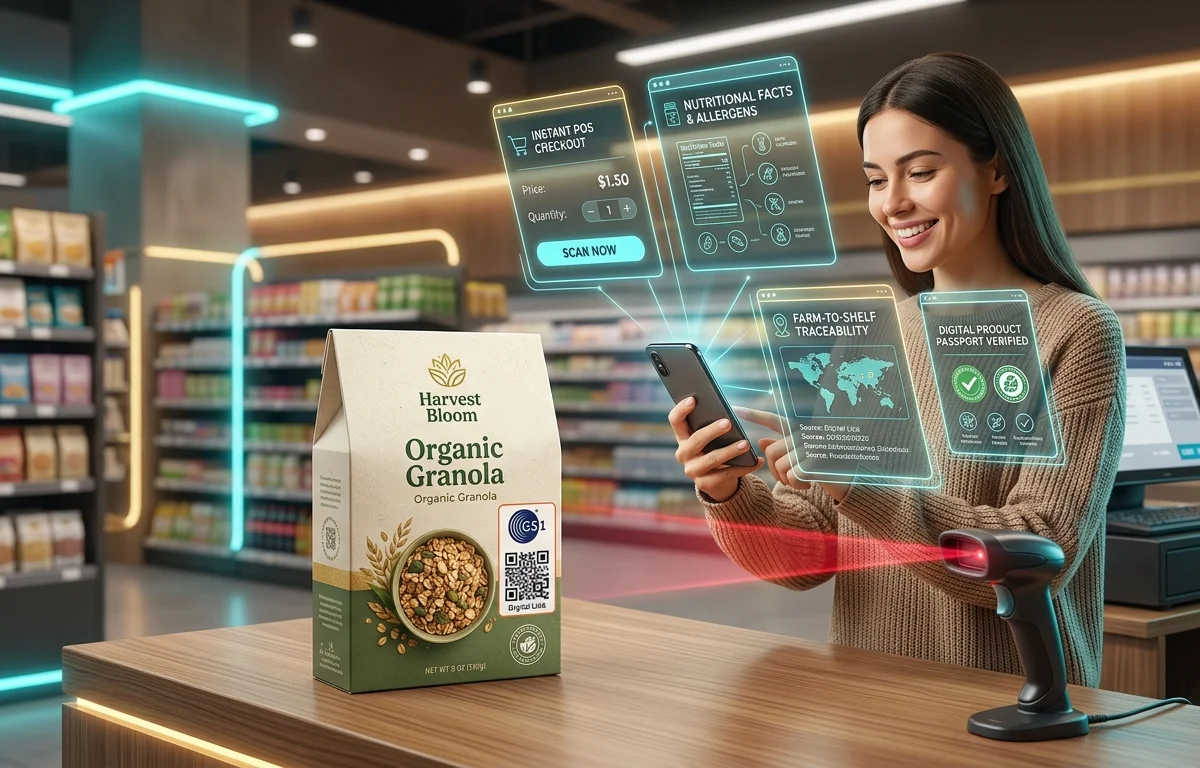
For more than fifty years, the familiar black-and-white vertical stripes of the UPC and EAN barcode have quietly powered global commerce. Every second, billions of products beep across supermarket cash registers worldwide. Yet, as consumer expectations evolve and regulatory mandates accelerate, this legacy 1D barcode has reached its technological limit. Enter GS1 Digital Link—the monumental standard underpinning the global retail industry's transition to 2D barcodes, officially codenamed Sunrise 2027. By uniting point-of-sale checkout scanning and consumer smartphone engagement into a single scannable symbol, GS1 Digital Link is revolutionizing product packaging and supply chain transparency.
Executive Summary & Key Takeaways:
- Strategic Shift: Replacing cluttered 1D barcodes and disjointed marketing labels with a single, web-enabled GS1 Digital Link QR code on retail packaging ahead of the global Sunrise 2027 retail mandate.
- Operational Efficiency: Reclaiming up to 70% of constrained packaging real estate while enabling automated checkout expiration date verification and instant batch-level recalls.
- Attribution & Consumer Engagement: Directing smartphone shoppers from the physical package directly to rich, interactive brand Smart Pages containing origin stories, allergen alerts, and sustainability metrics.
- Implementation Speed: Brand managers and packaging teams can generate, validate, and deploy standard-compliant GS1 2D codes in minutes using Bitsbender without expensive middleware.
Industry Context & The Root Problem
In 1974, a pack of Wrigley's chewing gum became the first item scanned with a 1D barcode at a supermarket checkout in Troy, Ohio. That breakthrough revolutionized inventory tracking and supermarket checkout speed. However, 1D barcodes suffer from an immutable design limitation: they can only hold between 8 and 14 numeric characters. They identify the generic product SKU (the Global Trade Item Number, or GTIN), but carry zero contextual intelligence—no expiration dates, no lot or batch identifiers, no serial numbers, and no interactive capabilities.
To overcome this limitation in recent years, manufacturers have resorted to crowding packaging with multiple disjointed marks: a traditional 1D barcode for retail cash registers, a promotional marketing QR code linking to the brand's website, a recycling instructions code, and a printed batch/expiry stamp. This approach creates severe operational and visual friction. It clutters packaging design, confuses consumers about which code to scan, and forces brands to dedicate precious packaging real estate to redundant machine-readable codes.
Furthermore, static 1D barcodes cannot protect consumers against food safety hazards. A supermarket checkout laser reading a standard UPC code cannot distinguish between a fresh yogurt carton and one that expired yesterday—the register merely sees the product SKU. If a brand issues a safety recall for a contaminated batch, retailers have no automated way to block the sale of affected units at the point of sale without pulling entire product lines off the shelves. The modern retail ecosystem demands a unified, cloud-connected data carrier that bridges the physical product to both optical cash registers and consumer smartphones.
Strategic Playbook & Core Architecture
The solution endorsed by global retail consortiums and technology leaders is the GS1 Digital Link standard. At its core, GS1 Digital Link converts traditional barcode data into a universal web URI (web address), turning the physical package into a dynamic, API-driven touchpoint.
1. The Universal URI Anatomy & Application Identifiers
Unlike traditional web URLs that link to a single static webpage, a GS1 Digital Link URI is structured according to precise international GS1 Application Identifiers (AIs). A standard-compliant Digital Link URL follows this syntax:
https://brand.com/01/05012345000008/10/LOT-9821/21/SER-4012?17=271231In this standardized schema:
- Key (01) — GTIN: Identifies the product's 14-digit Global Trade Item Number (SKU).
- Key (10) — Batch/Lot Number: Pinpoints the specific manufacturing batch for traceability.
- Key (21) — Serial Number: Provides unit-level identification for luxury, electronics, or serialized items.
- Key (17) — Expiration Date: Encodes the expiration date in standardized YYMMDD format.
2. The Dual-Purpose Resolution Layer: Cash Register vs. Smartphone
The true genius of the GS1 Digital Link standard lies in contextual redirection (link resolution). When an optical point-of-sale scanner at a supermarket checkout reads the 2D code, its decoding engine strips the web domain and extracts the embedded (01) GTIN and (17) Expiry Date. The cash register rings up the item instantly and halts the sale if the product has expired.
Conversely, when a curious consumer or store shopper scans the exact same QR code with a standard iPhone or Android camera, their phone opens the full web URL. The Bitsbender resolver detects that the scanner is a mobile browser and serves a rich, mobile-optimized AI-powered Smart Page customized to that exact product batch, displaying recipes, sourcing certifications, and allergen alerts.
3. Regulatory Compliance & The EU Digital Product Passport (DPP)
GS1 Digital Link is also the technological foundation of upcoming international regulatory mandates, including the European Union's Ecodesign for Sustainable Products Regulation (ESPR) and mandatory Digital Product Passports (DPP). By encoding supply chain provenance, recycled material percentages, and repairability indices into a standardized GS1 2D DataMatrix or QR code, brands maintain seamless compliance across international borders.
Step-by-Step Implementation Roadmap
Preparing your brand for the Sunrise 2027 transition is simple with Bitsbender. Follow this 5-step operational blueprint to launch your first GS1-compliant QR codes:
- Step 1: Obtain and Structure Your GTINs: Gather your official GS1-registered Global Trade Item Numbers (GTIN-12 for UPC or GTIN-13 for EAN). In Bitsbender, the system automatically validates check digits and formats your numbers into the standard 14-digit format required by GS1 specifications.
- Step 2: Build Your Contextual Brand Smart Page: Before generating the physical code, design a high-converting product Smart Page using Bitsbender. Add components for nutritional breakdowns, certified ingredient origins, dynamic video recipes, brand sustainability milestones, and direct review capture links using our retail QR solutions.
- Step 3: Configure GS1 Application Identifiers in Bitsbender: In the Bitsbender QR Studio, select the GS1 Digital Link code type. Enter your product domain, GTIN, and optional batch, serial, or expiration date fields. Bitsbender automatically constructs a fully compliant GS1 URI following the RFC 9264 Linkset specification.
- Step 4: Validate High-Contrast Packaging Geometry: Ensure your QR code adheres to GS1 print quality standards. Select high-contrast monochrome presets (dark modules on a crisp white background), maintain an adequate quiet zone (border margin), and export your vector artwork in resolution-independent SVG or high-DPI EPS format for your packaging pre-press workflow.
- Step 5: Run Pilot Scans on Optical POS Scanners: Before commencing mass printing runs, test your physical sample packages with both handheld optical retail scanners (such as Zebra or Honeywell 2D imagers) and modern smartphones to ensure 100% scan fidelity across all lighting conditions.
Comparative Strategy Matrix
How does the GS1 Digital Link standard compare to legacy 1D barcodes and generic marketing QR codes? Review the breakdown below:
| Strategic Dimension | Traditional 1D Barcode (UPC/EAN) | Generic Marketing QR Code | Bitsbender GS1 Digital Link 2D Code | Business Impact & ROI |
|---|---|---|---|---|
| Checkout POS Compatibility | Universal on legacy 1D laser scanners. | None. Cash registers cannot parse generic web URLs as product SKUs. | Full dual-compatibility with modern 2D optical retail scanners and registers. | Ensures compliance with global Sunrise 2027 retail mandates. |
| Consumer Engagement | Zero. Cannot be scanned by smartphone cameras without specialized scanner apps. | Static web link. No batch or unit-level intelligence. | Dynamic Smart Page with rich multimedia, origin maps, allergens, and promotions. | Unlocks direct-to-consumer (D2C) brand storytelling right from physical retail shelves. |
| Packaging Space Efficiency | Consumes substantial horizontal space; requires companion marketing QR codes. | Must sit next to 1D barcode, creating visual clutter and consumer confusion. | Single unified symbol replaces all barcodes, QR codes, and recycling marks. | Reclaims up to 70% of packaging real estate for brand artwork and storytelling. |
| Automated Expiry & Recall Control | Impossible. Register only reads generic SKU; expired items ring up normally. | Not linked to retail inventory or checkout systems. | Encodes batch (AI 10) & expiry (AI 17); register halts sale of expired or recalled lots. | Prevents catastrophic product liability claims and protects consumer health. |
| Regulatory & ESG Readiness | No support for sustainability or compliance telemetry. | Unstructured data unsuitable for government inspection audits. | Native support for EU Digital Product Passport (DPP), ESPR, and ESG metrics. | Future-proofs packaging against tightening international export regulations. |
Security, Compliance & Regulatory Standards
Deploying GS1 Digital Link across millions of retail packages demands enterprise-level reliability and data security:
- Sub-50ms Global Redirection: Bitsbender leverages high-availability Edge CDN networks to resolve GS1 redirects instantly, guaranteeing zero delay whether a consumer scans in London, Tokyo, or New York.
- DNS & Custom Domain White-Labeling: Brands host their GS1 Digital Link URIs on their primary brand domain (e.g.,
id.yourbrand.com), reinforcing brand trust and securing search engine authority. - Cryptographic Data Integrity: Link destinations and Digital Product Passport credentials are protected by strict HTTPS encryption and tamper-evident signatures, ensuring bad actors cannot hijack consumer redirects.
- Full RFC 9264 Linkset Compliance: Bitsbender supports standardized machine-readable Linkset discovery endpoints (
application/linkset+json), allowing regulatory compliance crawlers and recycling facilities to inspect product composition data automatically.
Frequently Asked Questions
What is "Sunrise 2027" and why does it affect my brand?
Sunrise 2027 is the global target date established by GS1 for retailers and brands worldwide to upgrade their point-of-sale checkout scanners to 2D optical readers capable of scanning GS1 QR codes and DataMatrix symbols. Brands that transition their packaging to GS1 Digital Link now will enjoy a massive first-mover advantage in consumer engagement and retail efficiency.
Do I have to discard my existing GS1 GTIN / UPC numbers?
No! GS1 Digital Link is built directly on top of your existing GTINs. You do not need to register new barcode numbers; you simply encode your existing GTIN into the standard GS1 web URI format using the Bitsbender generator.
Can a single GS1 QR code really be scanned by both cash registers and phones?
Yes. Modern 2D retail barcode imagers decode the embedded GS1 Application Identifiers to extract the item's GTIN for ringing up sales, while smartphone camera software recognizes the standard web URL and opens your brand's interactive Smart Page in the mobile browser.
How does GS1 Digital Link help with EU Digital Product Passport (DPP) compliance?
The European Union mandates that electronics, apparel, batteries, and consumer goods provide accessible ESG, lifecycle, and recyclability information via a standardized data carrier. GS1 Digital Link is recognized as the premier carrier standard, allowing regulators, recyclers, and consumers to inspect compliance records seamlessly from the same code.
Strategic Conclusion & Next Steps
The transition from 1D barcodes to GS1 Digital Link represents the most significant packaging innovation in half a century. Brands that cling to obsolete black stripes risk falling behind as major retailers prioritize 2D scanner automation and consumers demand instant product transparency. By consolidating point-of-sale efficiency, direct-to-consumer engagement, and sustainability compliance into one elegant 2D symbol, GS1 Digital Link turns every package into a smart, interactive asset.
Prepare your product catalog for Sunrise 2027 today. Explore our enterprise QR use cases, check out our transparent pricing plans, and start generating standard-compliant GS1 Digital Link QR codes on Bitsbender right now!
Written by The QR Generator Team
We are passionate about connecting physical assets and digital experiences through innovative Smart QR technology. Follow us for the latest guides, industry blueprints, and QR marketing best practices.
Learn more about our mission →Need a Custom QR Code?
Create dynamic, trackable, and branded QR codes with real-time scan metrics in seconds.
Create Free QR CodeContinue Reading

QR Codes for Nonprofits: Simplifying Donations & Volunteer Signups
Discover how nonprofits leverage dynamic QR codes and Smart Pages to eliminate donor friction, automate volunteer onboarding, and increase fundraising ROI.
Building Interactive Museum Exhibits with QR-Powered Audio Guides
Discover how cultural institutions use Bitsbender dynamic QR codes and AI smart pages to deliver immersive audio guides, boost visitor engagement, and track real-time analytics.
The Future of Contactless Payments: QR Code Wallets Beyond India and China
Discover how QR code wallets are transforming global transactions beyond Asia. Learn enterprise strategies using Bitsbender Smart QR codes.